
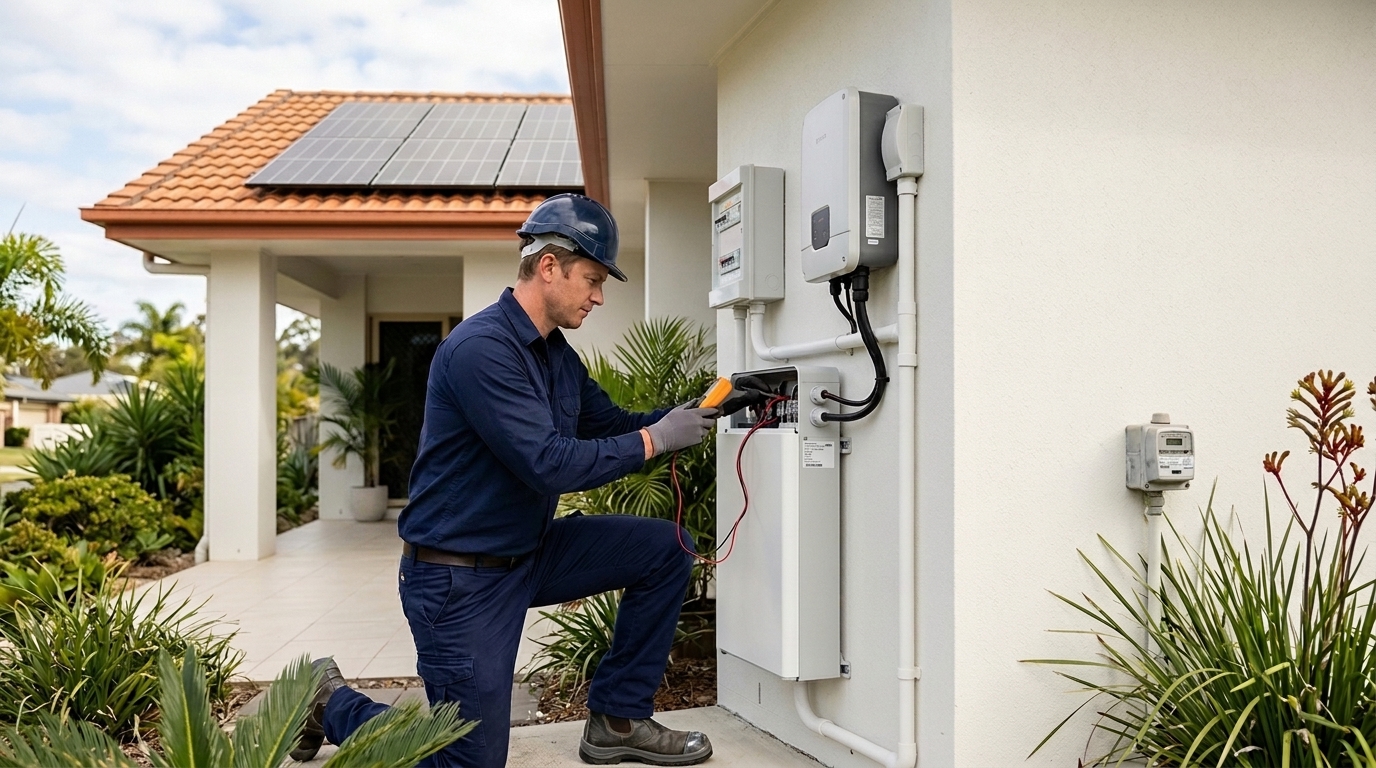
Yes, you can often add a battery to an existing solar system.The right setup depends on the condition and compatibility of your current equipment, how your household uses electricity and what you want the battery to achieve.
Compatibility is only the starting point. A suitable batter should also reflect how much surplus solar is available to charge it,how much electricity the household uses after sunset, and whether backup power is a priority.
Start with the solar system you already have
Start by confirming the system’s rated capacity, when it was installed, whether the panels and wiring are in good condition, and whether an export limit applies.
These details help show how much solar may be available to charge a battery, whether the existing equipment is likely to remain in service and whether the battery settings will need to account for network export restrictions.
An older solar system can still support a battery, but any faults or ageing components should be addressed before installation.
Check the inverter and coupling options
Some existing solar inverters are designed to work with a compatible battery, while others require a separate battery inverter or replacement with a hybrid inverter.
An AC-coupled battery uses its own inverter, so it can often be added without replacing the solar inverter already installed. Solar power is first converted to AC for the home, then converted again as it moves into and out of the battery.
With a DC-coupled setup, the panels and battery connect through a compatible hybrid inverter. Solar power can charge the battery before being converted to AC for use in the home, although retrofitting this configuration may require the existing inverter to be replaced.
The practical question is whether keeping the existing inverter would limit what you want the battery to do. If the inverter is still in good condition and an AC-coupled system can provide the required monitoring and backup, replacing it may add cost without enough benefit. If the inverter is ageing or cannot support those functions, moving to a compatible hybrid inverter may make more sense.
Check whether the switchboard needs an upgrade
Adding a battery may require additionalconnections and protection equipment at or near the switchboard.. If the existing board cannot safely accommodate the required equipment, it may need to be upgraded. This does not rule out a battery, but it can change the scope and installed cost.
The need for an upgrade should be confirmed before you accept a proposal. The quote should state whether switchboard work is required and whether it is included, rather than leaving it as an additional cost discovered on installation day. Any switchboard changes must be assessed and completed by a licensed electrician.
Find a suitable battery location
Choosing a battery location involves more than finding enough wall space. . Its position must meet installation rules, including required clearances from doors and windows. Exposure to direct sun or possible vehicle impact can also rule out an otherwise convenient spot, while a long cable run to the switchboard may add complexity and cost.
For that reason, confirm the location on site before choosing the final system. An installer should be able to show where the battery can go and explain any limitations.
Use your energy data to size the battery
Inverter monitoring can show how much solar the system generates, while smart-meter data can reveal when the home imports and exports electricity. Regular daytime exports indicate how much solar may be available to store. Evening and overnight imports show how much stored energy the household could realistically use.
Review the data across a representative period because solar generation and household demand change over time. These patterns can help estimate an appropriate usable battery capacity. A battery that is much larger than the home’s regular solar surplus or after-sunset demand may add cost without being used effectively. Expected changes, such as purchasing an electric vehicle or electrifying more household appliances, should also be considered.
Check whether grid charging would actually help
Grid charging allows a battery to store electricity from the grid when rates are lower and use it during a more expensive tariff period. This may be useful when there is not enough surplus solar to fill the battery, particularly during periods of lower generation. It can also help maintain a reserve for an outage if the system supports that function.
The price difference needs to be large enough to account for energy lost while charging and discharging the battery. On a flat tariff, or where the difference between off-peak and peak rates is small, grid charging may offer little or no financial benefit. Any modelling should use the household’s current tariff, expected charging and discharging losses, and likely usage pattern rather than assuming grid charging will reduce the electricity bill.
Define the backup scope
Many homeowners add a battery so they can keep essential parts of the home running during a grid outage. That outcome needs to be designed into the system, and even a backup-capable system may not power the entire property.
Depending on the design, selected backup circuits might support lighting, refrigeration, internet equipment or nominated power points. High-demand appliances, including some air conditioners, electric ovens, pool equipment and hot-water systems, may exceed the battery or backup system’s output limits.
Ask which circuits will remain available, how much power the battery can supply at one time and whether the solar panels can continue charging it while the grid is unavailable. The answer will depend on the battery, inverter, backup hardware and system configuration.
Know how the system will be monitored and supported
Monitoring helps you understand whether the battery is operating as expected. The app should clearly show how energy is moving between the solar system, battery, home and grid.
If the data shows a problem, you should also know who to contact. Confirm whether the installer or manufacturer will handle support, whether labour is covered and whether adding the battery affects the warranty on your existing solar equipment. This is more useful than relying on the battery warranty period alone.
Assess the complete system before adding a battery
Adding a battery to an existing solar system is often possible, but suitability depends on more than product compatibility. A proper assessment should consider the existing equipment, inverter, switchboard, proposed battery location, energy data, capacity, grid-charging options and backup priorities.
This process cannot guarantee a particular saving or payback period. It can provide a clearer view of whether a battery suits the existing system, how it should be configured and whether it is likely to support the household’s energy goals.
Thinking about adding storage to your current solar system? Let’s talk, and we’ll assess your existing equipment, energy use and backup priorities to help determine whether a battery suits your home.